ABOUT

Why Choose LAS?
👤 CLIENT: I’ve looked at your website. I understand animation—but I’m not clear on why we would hire you as a strategic consultant. Can you explain what you actually do?
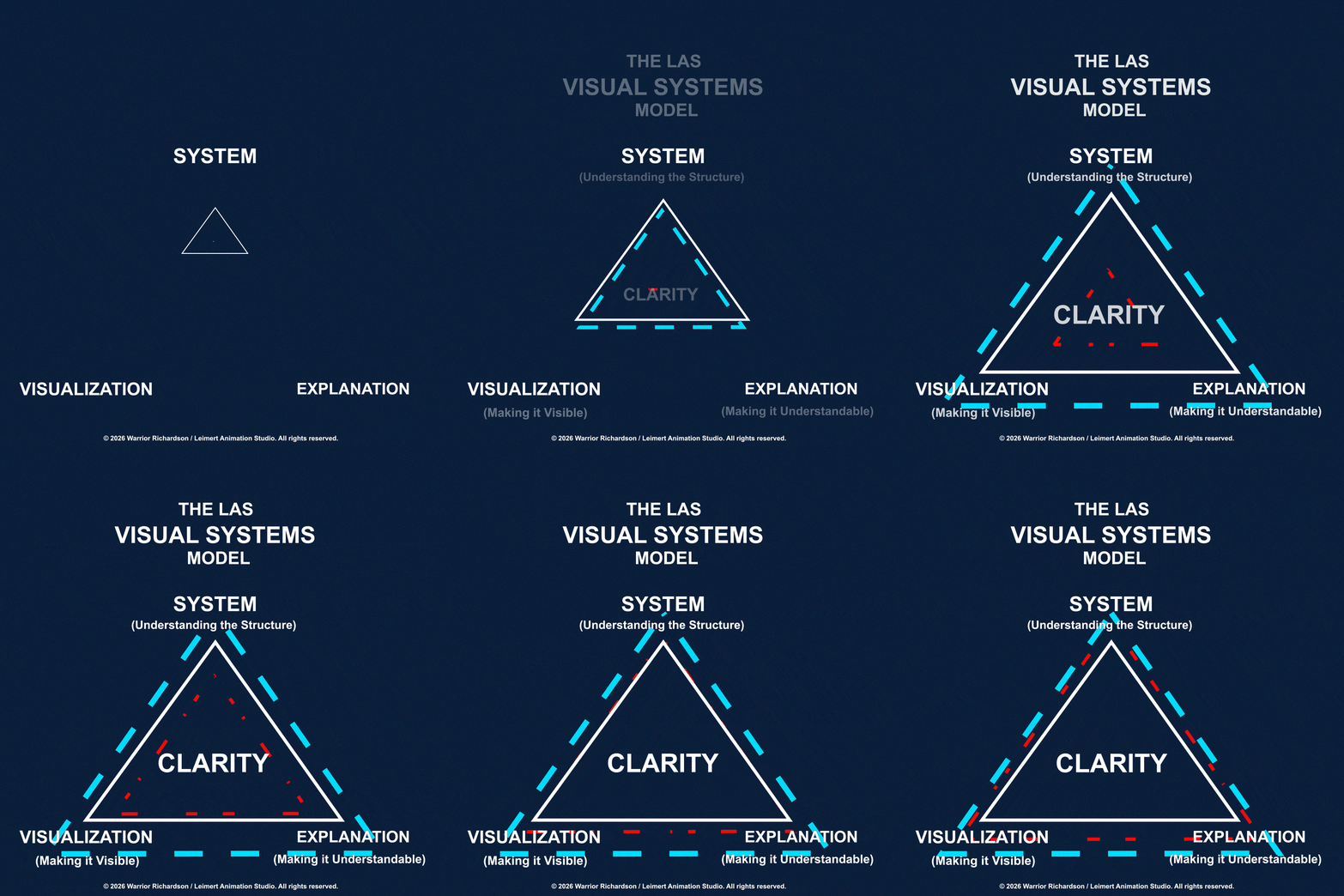
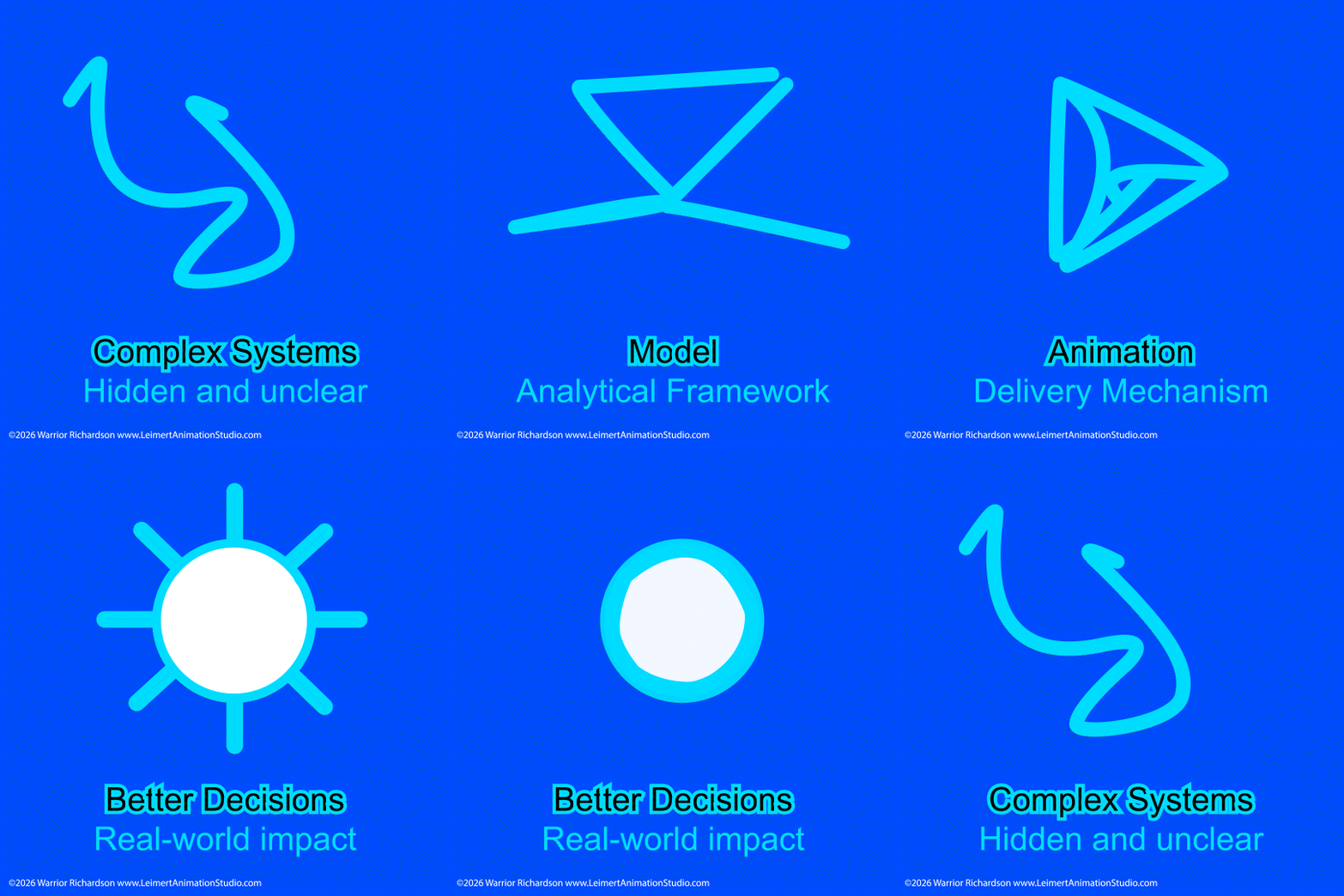
🧠 LAS: That’s a fair question—and the distinction is important. Leimert Animation Studio designs decision-support systems and uses animation as the medium to make those systems visible, understandable, and actionable. In practical terms: We take complex environments (economic systems, cultural ecosystems, institutional processes) We model how they actually function Then we translate that model into a visual system your team can see, reason about, and make decisions from So the value is not “a video.” The value is clarity that improves decisions.
👤 CLIENT That sounds good in theory—but we already have analysts, reports, and dashboards. Why do we need this?
🧠 LAS: You likely have data and analysis. What you probably don’t have is structural clarity that is shared across decision-makers. Most organizations struggle with:
-
Fragmented understanding across teams
-
Over-reliance on documents that don’t translate into action
-
Inability to see how parts of a system interact
What we build is: A shared mental model of your system — made visible. When people can see the system, three things happen:
1. Decisions become faster
2. Alignment improves across stakeholders
3. Strategy becomes grounded in structure, not opinion
👤 CLIENT Let’s talk about money. How do you justify your pricing? What’s the ROI?
🧠 LAS: We price based on decision impact, not production time. So the question becomes: What is the cost of unclear decisions in your organization? For example:
-
Delayed initiatives
-
Misaligned teams
-
Ineffective programs
-
Lost opportunities
If a clearer system model helps your team:
-
Avoid one failed initiative
-
Align faster across departments Or
-
identify a high-impact opportunity
the return typically exceeds the engagement cost many times over. We’re not competing with production vendors. We’re closer to strategy consultants—just with a more effective delivery medium.
👤 CLIENT Okay—so what exactly would you deliver? Walk me through a project.
🧠 LAS: A typical engagement has three phases:
1. We work with your team to identify: Key actors Flows (money, people, information) This is where most of the strategic value is created.
2. System Modeling: We construct a formal model of your system: Relationships between components Feedback loops Points of leverage This becomes the foundation for everything.
3. Visual Translation: We translate that model into: A visual systems diagram A short animation that explains it clearly
Optional: internal or external communication assets
👤CLIENT I worry this might oversimplify things. Our systems are very complex.
🧠 LAS: That’s exactly why this work is valuable. We don’t simplify by removing complexity. We simplify by structuring it correctly. There’s a difference between:
Oversimplification → misleading Structural clarity → usable
Our goal is:
Preserve complexity, but make it intelligible.
If your system cannot be explained clearly, it usually means: It’s not fully understood yet
Or it’s not structured optimally
👤 Have you done this before? Or is this experimental?
🧠 LAS: The approach draws from established disciplines:
-
Economic modeling
-
Systems thinking
-
Decision theory
What’s new is how we integrate them into a visual medium. I’m currently applying this framework to a real-world system:
a micro-district economic and cultural ecosystem in Los Angeles.
That project is helping refine:
The modeling approach
The visual grammar
The decision-making applications
So while the integration is innovative, the foundations are rigorous.
👤 How long does this take? We don’t want something that drags on.
🧠 LAS: We design engagements to be focused and efficient. Typical timeline: 1–2 weeks
Modeling: 1–2 weeks
Visual translation: 1–2 weeks
So roughly 3–6 weeks total, depending on scope. We avoid open-ended engagements. The goal is clarity delivered quickly.
👤 CLIENT What if our team doesn’t actually use this?
🧠 LAS: YOU That’s a critical risk—and we design around it. We ensure adoption by:
1. Building with your team, not for your team
2. Focusing on decisions they already need to make
3. Delivering outputs that are: Immediately understandable Easy to share Useful in meetings If a model isn’t used, it failed—regardless of how good it looks.
👤 CLIENT: There are a lot of consultants out there. Why should we choose you?
🧠 LAS: YOU: Because we solve a problem most consultants don’t address: The gap between understanding and action. Many consultants: Deliver reports Provide recommendations But those often fail because: Stakeholders don’t fully internalize them The system isn’t clearly understood What we do differently: We build the system itself Then make it visually undeniable So instead of telling you what to do… We show you how your system actually works—so the right decisions become obvious.
🔴 OBJECTION 1: “This sounds like animation. Why is this so expensive?”
🧠 LAS: This isn’t priced as animation—it’s priced as decision clarity. Animation is just the medium. What you’re paying for is: Understanding your system Structuring it correctly Making it usable for decision-making If all you needed was animation, you could get that cheaper.
But if you need:
Alignment across stakeholders
Clear understanding of how your system works
Better decisions
That’s a different category of value.
🔴 OBJECTION 2: “We can’t justify this budget right now.”
🧠 LAS: Understood. The real question is: What is the cost of
continuing without clarity?
Misaligned initiatives
Wasted resources
Missed opportunities
If this work helps you avoid even one misstep, it often pays for itself. If budget is tight, we can scope a smaller entry point—but I wouldn’t recommend doing nothing.
🔴 OBJECTION 3: “We already have consultants.”
🧠 LAS: That’s actually ideal. We don’t replace consultants—we make their work usable.
Most consulting outputs:
Live in documents
a) Are interpreted differently by different stakeholders
b) We take that complexity and turn it into:
c) Strategic Consultancy Dialogue
d) A shared, visual understanding that everyone can act on.
🔴 OBJECTION 4: “This feels abstract.”
🧠 LAS: It only feels abstract until you see your system. Once we map:
Who is involved
How value flows
Where constraints exist
it becomes very concrete. Most organizations operate inside systems they’ve never fully visualized. We make that visible.
🔴 OBJECTION 5: “What exactly do we walk away with?”
🧠 LAS: You walk away with three things:
1. A clear model of your system:
How it works
Where leverage exists
2. A visual diagram Usable in strategy discussions Aligns your team instantly
3. A short animation Explains the system clearly: Internally or externally
But the real deliverable is: A shared understanding your team can actually use.
🔴 OBJECTION 6: “How do we know this will work for us?”
🧠 LAS: We structure engagements to minimize risk:
Tight scope
Clear phases
Early visibility into the model
You’re not waiting until the end to see value—you see it as we build.
🔴 OBJECTION 7: “This seems too simple for our complexity.”
🧠 LAS: Clarity often looks simple—but it’s hard to achieve. We’re not removing complexity—we’re: Organizing it so it can be understood. If something is too complex to explain clearly, it’s usually not fully understood yet.
🔴 OBJECTION 8: “Can’t we just do this internally?”
🧠 LAS: You can—but it’s very difficult from the inside. Why?
You’re embedded in the system
Assumptions go unchallenged
Blind spots persist.
We bring:
Structured modeling
External perspective
A disciplined process
Strategic Consultancy Dialogue
🔴 OBJECTION 9: “What if our team doesn’t use it?”
🧠 LAS: That’s a valid concern. We design for usage by: Involving your team in the process :
Anchoring everything to real decisions
Delivering something intuitive and usable
If it’s not used, it failed—so we build to prevent that.
🔴 OBJECTION 10: “Why should we trust this approach?”
🧠 LAS: The foundations are not experimental:
Economics
Systems thinking
Decision theory
What’s new is the integration and delivery. We’re not inventing theory—we’re improving how it’s applied and understood.
Reveal the full structure at a glance
1️⃣ Are people struggling to understand how your system actually works?
If stakeholders cannot easily explain the relationships between actors, incentives, and outcomes, a visual
systems model can make the structure clear.
2️⃣ Do your reports or presentations fail to communicate the big picture?
Many organizations produce large amounts of documentation, but the overall system remains difficult to see.
Animation can reveal the full structure at a glance.
3️⃣ Are decisions being made without a shared understanding of the system?
When people hold different mental models of the same system, coordination becomes difficult.
Visual models create shared understanding.
4️⃣ Do you need a clearer way to explain your work to the public?
Complex work often fails to reach broader audiences because the explanation is too technical.
Animated models translate complexity into accessible visual stories.
5️⃣ Are you trying to understand how decisions ripple through a system?
Economic and institutional systems are interconnected.
Our decision-theoretic modeling approach helps reveal how choices propagate through networks of actors.
What LAS Does
Leimert Animation Studio develops visual systems models that help audiences understand complex economic
and social dynamics.
Using animation and decision-theoretic modeling, LAS reveals:
• how neighborhood economies function
• how policy decisions ripple through communities
• how cultural districts sustain economic ecosystems
thereby revealing how they actually work.
Why This Matters
Most discussions about urban communities rely on anecdotes or political narratives.
LAS provides a structural visual approach that allows audiences to see:
• decision points
• economic flows
• feedback loops
• long-term consequences
Systems Thinking
↓
Economic Modeling
↓
Visual Storytelling
↓
Public Understanding
Actors
↓
Decisions
↓
Flows
↓
Cultural Gravity
↓
Outcomes
Interdisciplinary by Design
Warrior Richardson began his professional life in economic policy analysis before returning to visual art — the discipline that first shaped his thinking.
Over time, it became clear that culture and economics are not separate domains. They are interwoven systems. Leimert Animation Studio was formed at that intersection.
Our work reflects a simple premise: If we understand the structure of a cultural ecosystem, we can communicate it with precision.
Each engagement is personally directed — from structural modeling through final narrative execution — ensuring intellectual coherence and artistic integrity.
We collaborate with a curated network of creative specialists when scale requires it, while maintaining centralized strategic oversight.
Areas of Practice
-
Cultural Ecosystem Modeling
-
Mapping the relationships between artists, vendors, public space, institutions, and economic flows.
-
-
Strategic Narrative Development
-
Translating structural insight into clear visual frameworks for boards, funders, and communities.
-
-
Impact & Funding Visualization
-
Strengthening institutional communication by clarifying how mission translates into measurable outcomes.
-
-
Institutional Partnerships
-
Selective, founder-led collaborations designed to support long-term cultural and economic development initiatives.
Frequently asked questions
- 01
- 02
- 03
- 04
- 05
- 06
- 07
- 08
- 09
- 10
- 11
- 12
- 13
- 14
- 15
- 16
- 17


.jpg)