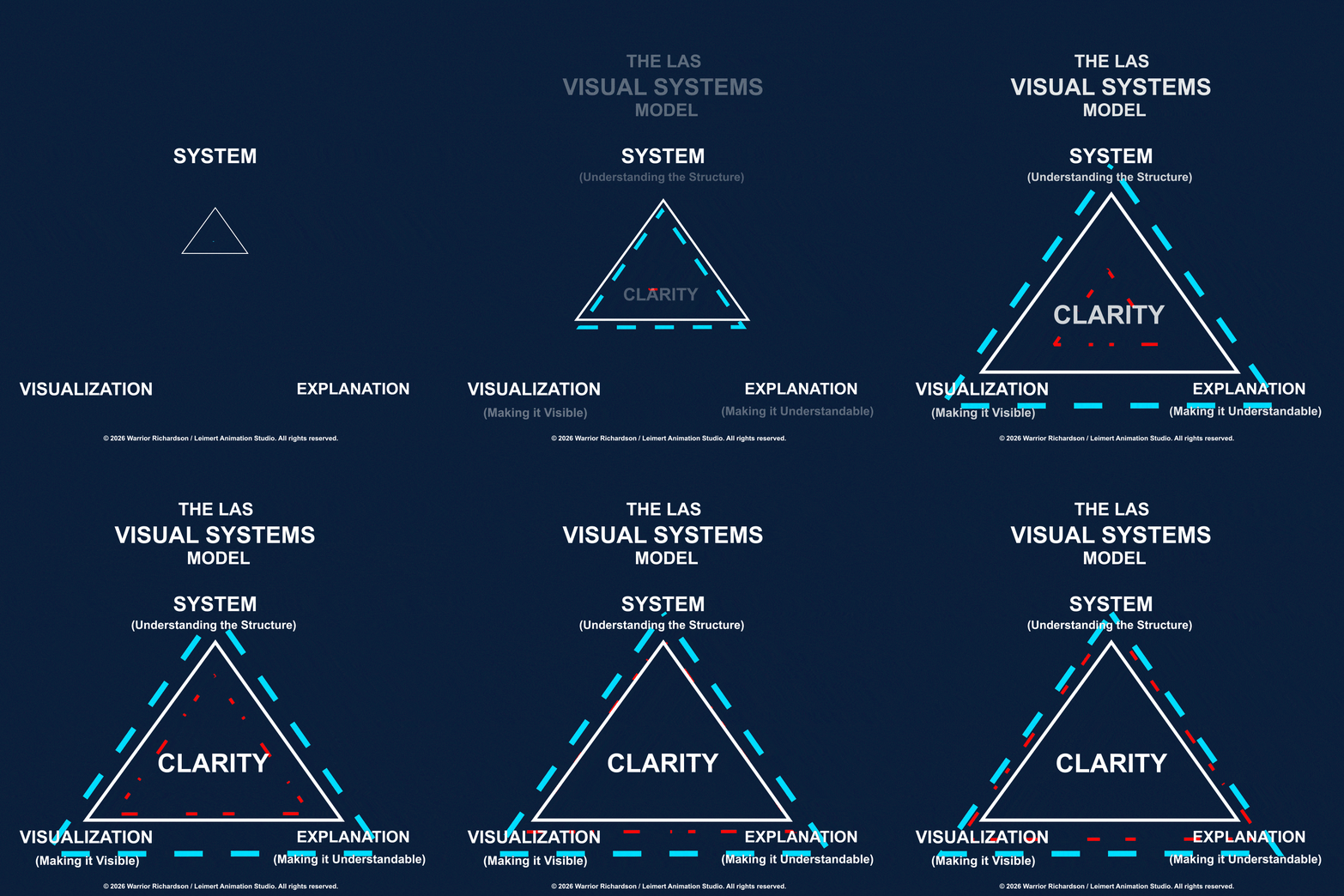
The LAS Method
LAS helps organizations create clarity, improve decisions, and unlock value.
Leimert Animation Studio began with a simple observation: many important decisions are made within systems that the people inside them don't fully understand. Developing the LAS Method required confronting that same challenge—learning how to take complex models and reveal their structure, relationships, and decision logic. Today, LAS applies that same process to help organizations understand their own systems more clearly."
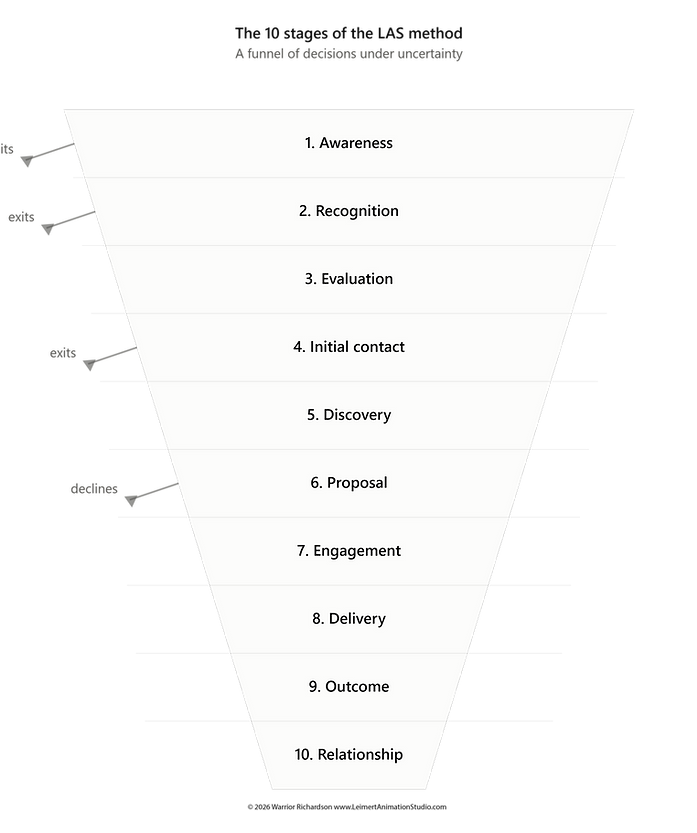
Complex systems often contain hidden value. On this page, I present the LAS Method as a sequence of decisions under uncertainty, where both the client and LAS weigh their options to get the best results.
Animation is not our product.
Clarity is.
Animation = delivery mechanism
Model = analytical framework
Clarity = value
Better decisions = impact
The Mechanism Behind the LAS Method
How does LAS make complex systems understandable?
The LAS Method combines four complementary disciplines into a single analytical framework.
Why animation?
Animation reveals reasoning over time.
Instead of presenting conclusions, it allows people to follow the logic step by step.
Why economics?
Economics focuses on incentives, tradeoffs, and constraints—the forces that often drive decisions within complex systems.
Why systems thinking?
Individual decisions rarely exist in isolation.
Systems thinking reveals how decisions interact to produce outcomes.
Why utility functions?
Utility functions provide a disciplined way to infer the decision logic behind observed behavior.
Rather than relying solely on stated intentions, the LAS Method analyzes the choices decision-makers actually make.
One coherent methodology
Animation communicates the reasoning.
Economics explains incentives.
Systems thinking reveals relationships.
Utility functions infer decision logic.
Together, these disciplines enable LAS to make complex systems understandable.

The 10 Stages of the LAS Client Journey
Stage 1: Awareness
Client State
The client experiences a problem:
-
Communication is unclear.
-
Stakeholders disagree.
-
A system is difficult to explain.
-
Complexity is preventing action.
The client may not yet know LAS exists.
Decision
Should I continue operating with my current understanding or seek outside assistance?
Possible actions:
-
Ignore problem
-
Continue existing approach
-
Seek consultant
-
Seek LAS
Stage 2: Recognition
Client encounters LAS.
Examples:
-
Website
-
Social media
-
Referral
-
Presentation
-
Case study
Client learns:
"LAS does not merely create animation.
LAS takes complex visual decision models and makes them clearly understood."
Decision
Is my problem significant enough to justify further investigation?
Possible actions:
-
Leave website
-
Save for later
-
Contact LAS
Stage 3: Evaluation
Client investigates.
Questions include:
-
Can LAS solve my problem?
-
Is the methodology credible?
-
Is the cost justified?
-
Do I trust this organization?
Client Objective
Reduce uncertainty.
LAS Objective
Demonstrate value.
Stage 4: Initial Contact
Client reaches out.
Information exchange begins.
LAS attempts to identify:
-
Objectives
-
Constraints
-
Stakeholders
-
Desired outcomes
Decision
Should both parties proceed?
Possible outcomes:
-
No fit
-
Future opportunity
-
Proceed to discovery
Stage 5: Discovery / Model Construction
LAS gathers information.
Activities:
-
Interviews
-
Documentation review
-
Systems mapping
-
Utility function identification
Client Decision
Provide deeper access?
LAS Decision
Invest additional effort?
Stage 6: Proposal
LAS presents:
-
Scope
-
Deliverables
-
Timeline
-
Price
Decision
Accept proposal?
Possible outcomes:
-
Accept
-
Negotiate
-
Decline
Stage 7: Engagement
Project begins.
LAS creates:
-
Diagrams
-
Simulations
-
Animations
Client evaluates progress continuously.
Stage 8: Delivery
LAS presents final product.
Client learns:
-
New relationships
-
Constraints
-
Tradeoffs
-
Strategic opportunities
Decision
Implement insights?
Stage 9: Outcome
Client experiences:
-
Better understanding
-
Improved communication
-
Better decisions
-
Reduced uncertainty
Stage 10: Long-Term Relationship
Satisfied clients may:
-
Purchase additional services
-
Refer others
-
Become collaborators
At this point trust becomes a valuable asset.
---------------------------------------------------
The result is not simply an animation.
The result is a clearer understanding of the system,
better decisions, reduced uncertainty, and the ability to unlock value that may have previously gone unnoticed.
_
What Makes LAS Different?
Traditional Report
Text
Text
Text
Text
Text
_
LAS
Structure
↓
Actors
↓
Incentives
↓
Flows
↓
Feedback
↓
Decision Pathways
The System Model
Knowledge
│
▼
Models
│
▼
Visualizations
│
▼
Understanding
│
▼
Better Decisions
│
▼
Real-World Impact
_
Why Animation?
Complex System



///////////////